

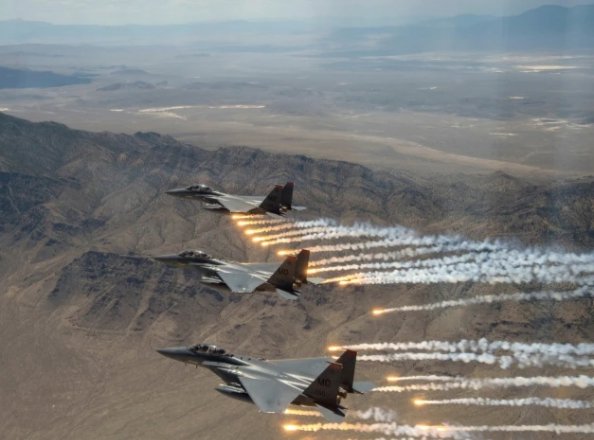
The Unfiltered Truth | International Desk | July 19: Tensions in the Middle East have escalated sharply after the United States launched a fresh wave of airstrikes targeting Iranian military facilities in response to the killing of American troops in Jordan. The latest exchange of military action has heightened fears of a broader regional conflict, with governments around the world closely monitoring the rapidly evolving situation.
According to U.S. officials, the airstrikes were carried out against multiple Iranian military installations, including missile launch sites, drone storage facilities, air defence systems, and bases linked to the Islamic Revolutionary Guard Corps (IRGC). The U.S. administration described the operation as a direct response to the attack that resulted in the deaths of American service members stationed in Jordan, stating that the objective was to reduce Iran’s capability to launch future attacks against U.S. personnel and allied forces in the region.
Officials in Washington maintained that the strikes were aimed at military infrastructure rather than civilian targets. However, Iranian authorities condemned the operation, calling it an act of aggression and a violation of international law. Tehran warned that it would respond firmly to what it described as an unjustified attack on its sovereignty.
Within hours of the U.S. strikes, Iran launched a series of missiles and drones toward locations associated with American allies across the Middle East. Air defence systems in several countries reportedly intercepted many of the incoming projectiles, preventing wider damage. Nevertheless, the retaliation has significantly increased concerns that the confrontation could expand beyond the two nations and involve other regional actors.
Military analysts believe the latest escalation marks one of the most serious confrontations between Washington and Tehran in recent years. The exchange of attacks has raised the possibility of prolonged military engagement, with security forces across the region remaining on heightened alert.
The renewed conflict has also drawn attention to the Strait of Hormuz, a strategically vital waterway through which a significant portion of the world’s oil supply passes every day. Any disruption to shipping through the strait could have major consequences for global energy markets, potentially leading to higher oil prices and increased economic uncertainty. International shipping companies are reportedly reviewing security measures as tensions continue to rise.
Global leaders have appealed for restraint, urging both countries to avoid further military escalation and instead pursue diplomatic engagement. Several governments have expressed concern that continued hostilities could destabilize the broader Middle East, affect international trade, and worsen the humanitarian situation in the region. International organizations have also called for dialogue to prevent the conflict from spiralling into a wider war.
Security experts note that the latest developments come after diplomatic efforts to ease tensions failed to produce a lasting breakthrough. The breakdown of previous attempts at de-escalation has left the region increasingly vulnerable to further military incidents, making the current situation particularly volatile.
Financial markets are also closely watching the conflict, as prolonged instability in the Middle East often affects global oil prices, investor confidence, and international supply chains. Analysts warn that any sustained military confrontation involving key regional powers could have far-reaching economic implications beyond the region itself.
As of now, both the United States and Iran remain on high military alert, while diplomatic channels continue to operate in an effort to prevent further escalation. The situation remains fluid, and officials have indicated that developments are being monitored around the clock.
With military operations continuing and tensions showing little sign of easing, the international community faces growing concern that the conflict could evolve into a broader regional crisis unless urgent diplomatic efforts succeed in reducing hostilities.